



Westerbork

After their arrest, most Jews were taken to the Westerbork “Police Transit Camp” for Jews. From there, deportation trains departed for the Auschwitz and Sobibor extermination camps, but also for the Bergen-Belsen concentration camp and the Theresienstadt ghetto. Because the Tal and Levenbach families had papers for entry into Palestine, they were taken to Bergen-Belsen. The Reiner family arrived in Westerbork later, after deportations had already ceased.
What did the Levenbach family experience upon arrival in Westerbork?
Annelie, her brother Joost and their parents, Elisabeth and Dolf Levenbach, met a friend who was in Westerbork as an employee of the Jewish Council, not as a camp prisoner, Curt Blüth. He knew his way around the camp and made sure that the Levenbach family was not immediately deported.
© NIOD, Beeldbank WO2, No. 161916
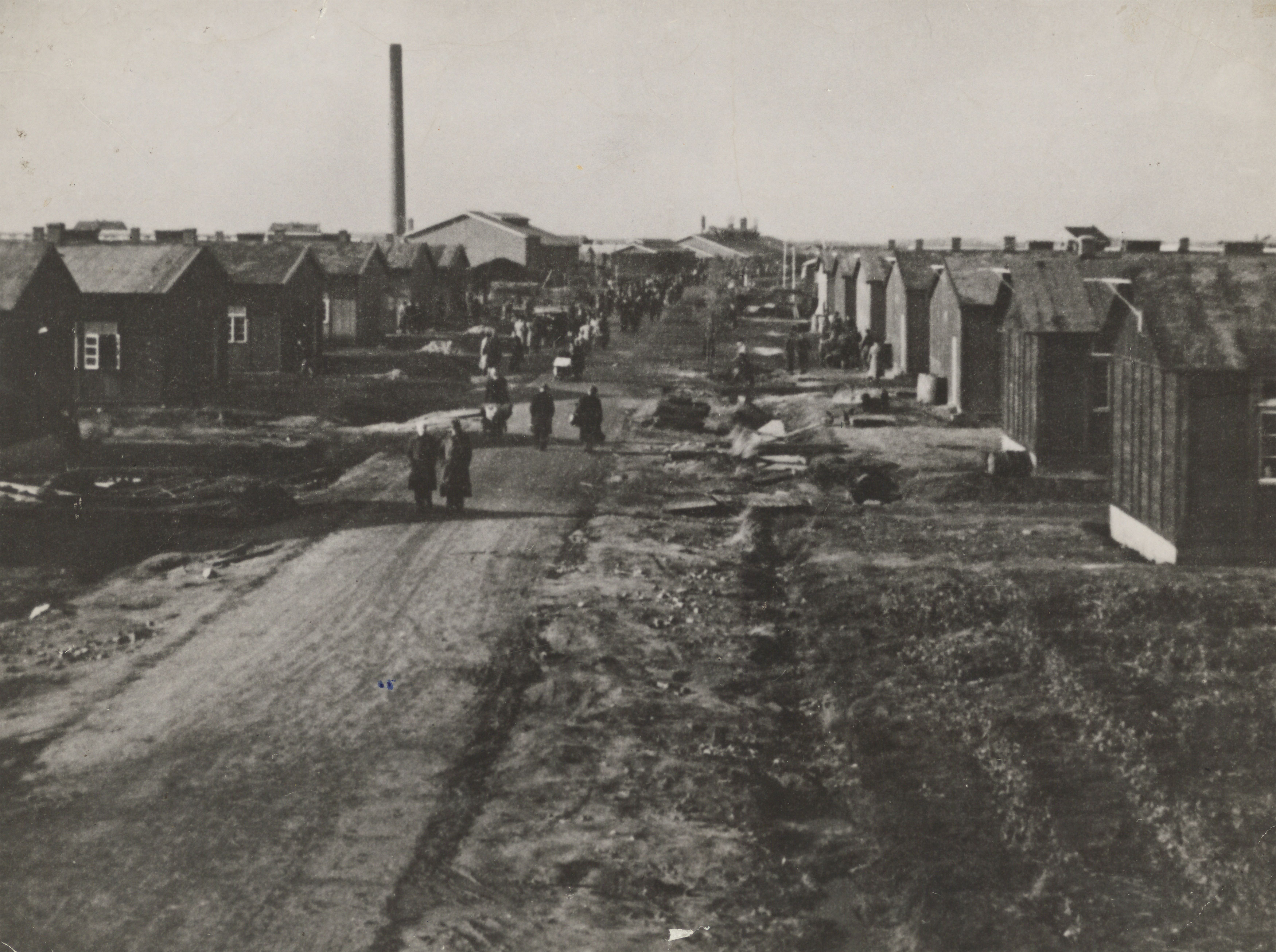
The main road of the camp, nicknamed the “Boulevard des Misères”, formed the centre of the transit camp.
After a railway line was extended into the camp in late 1942, transport trains carrying prisoners arrived and departed from the camp’s main road. Before this, trains had stopped at the Hooghalen station five kilometres away and prisoners were forced to carry their heavy luggage and walk the rest of the way to the camp on foot.
On the platform in Westerbork, we met Curt Blüth, a partner of my father and a good friend of my parents. Weiter

He saw that my father and uncle’s IDs were signed with the letter “S”, which stood for “Strafe” (punishment), and he immediately tore them into small pieces and put them in his pocket. This saved us. Holders of an ID with an “S” on it were sent on the first train to an extermination camp. The stamp was put in my father’s and uncle’s cards because the Nazi manager who replaced my uncle in the business wanted to get rid of him.
© United States Holocaust Memorial Museum, Washington, D.C., No. 08049. Courtesy of Toni Heller
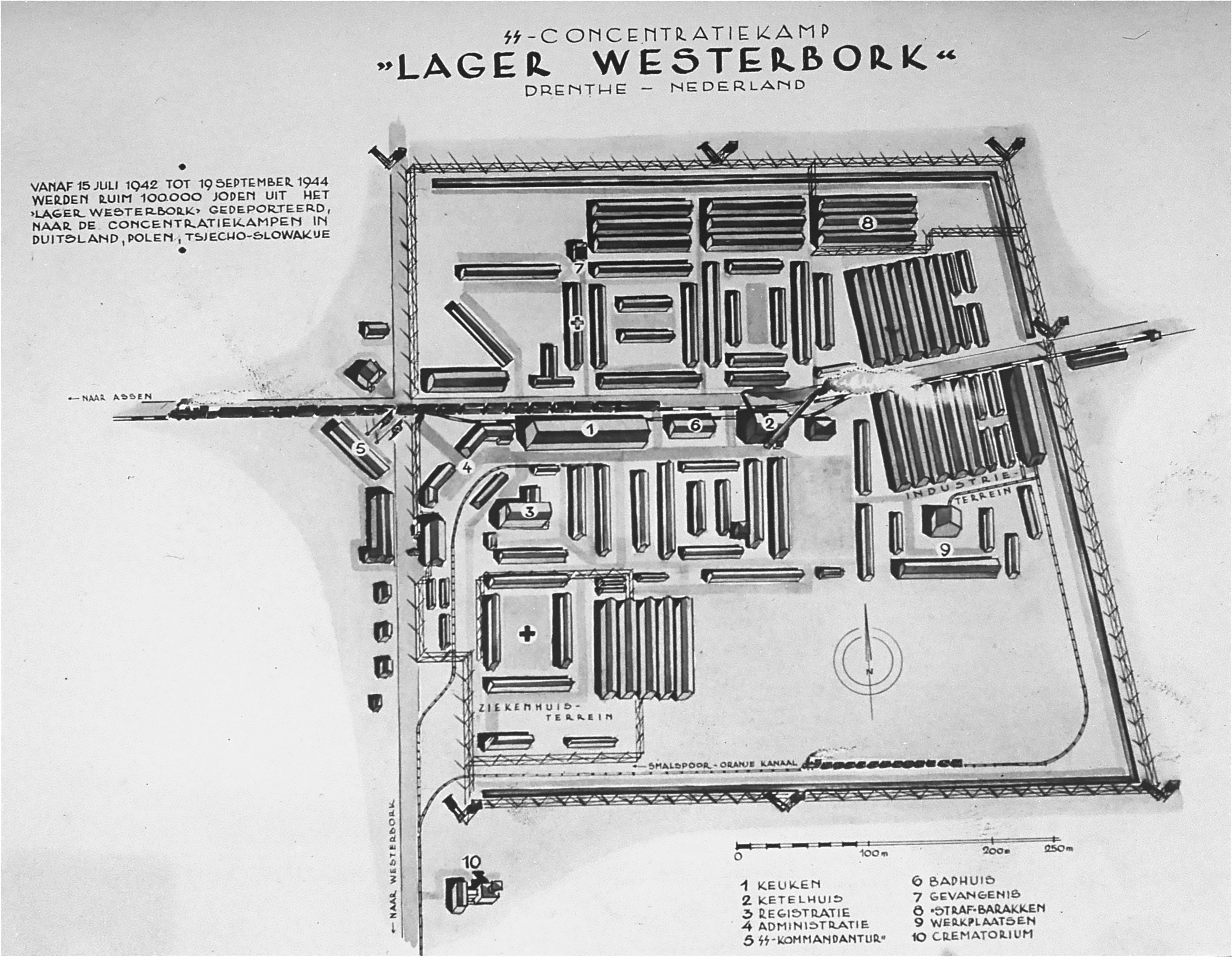
Transcription
From 15 July 1942 to 19 September 1944, more than 100,000 Jews were deported from “Lager Westerbork” to concentration camps in Germany, Poland and Czechoslovakia.
1 Kitchen
2 Boiler House
3 Registration
4 Administration
5 SS Command Headquarters
6 Bathhouse
7 Prison
8 Punishment Barracks
9 Workshops (Industrial Area)
10 Crematorium
[without numbering:]
Naar Assen – To Assen
Ziekenhuis-Terrein – Hospital Grounds
Smalspoor – Oranje Kanaal – Narrow-gauge railway – Oranje Canal
Naar Westerbork – To Westerbork
The Westerbork camp, which was established as the central refugee camp for the Netherlands in November 1939, became a “Police Transit Camp” of the German occupiers on 1 July 1942.
After the November pogroms of 1938, many Jews fled from Germany to the Netherlands. The Dutch government decided to house the newly arrived refugees in a central camp that it established north of the Westerbork village in the province of Drenthe in the northeast of the country.
In the event of a German attack on the Netherlands, the plan was to have the Jews from Westerbork evacuated and taken to Great Britain, but this never happened.
After the Dutch surrendered on 15 May 1940, the Dutch authorities decided to accommodate all Jewish refugees in Westerbork. The new camp commander introduced tighter operations, stricter discipline and intensified surveillance. The German occupiers adopted these structures when they took over the camp on 1 July 1942.
The information on the number of deportees and the destination of the transports suggests that the map was probably created after the liberation on 12 April 1945.
First, we went to the registry, then to the administration, then to quarantine for delousing. Of course, we didn’t have lice.
How were the living conditions in the Westerbork transit camp?
The housing barracks were overcrowded and the hygienic conditions poor, but the prisoners did not suffer from hunger or experience physical abuse. Those who were not deported immediately had to work; children attended classes.
© NIOD, Beeldbank WO2, No. 66314
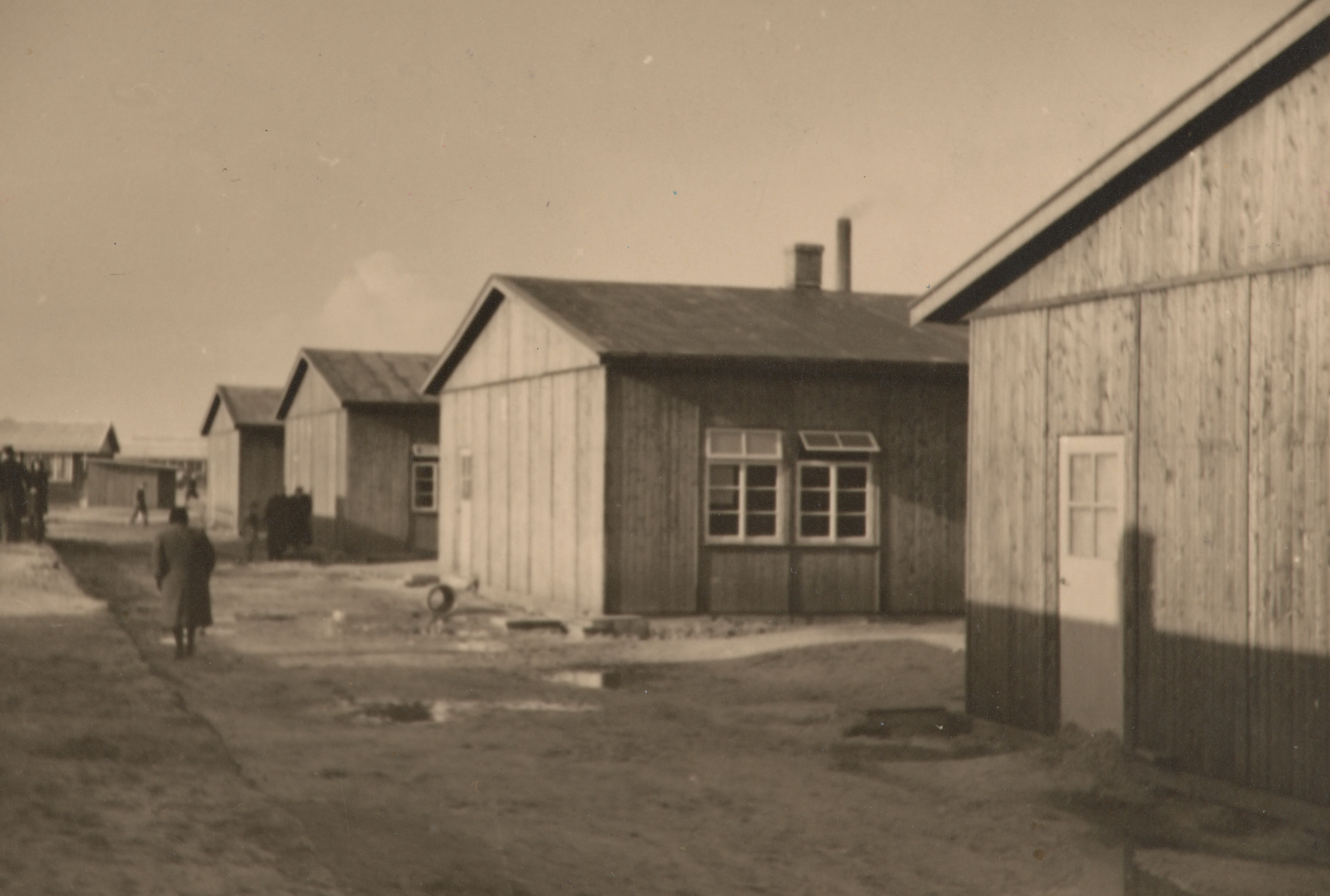
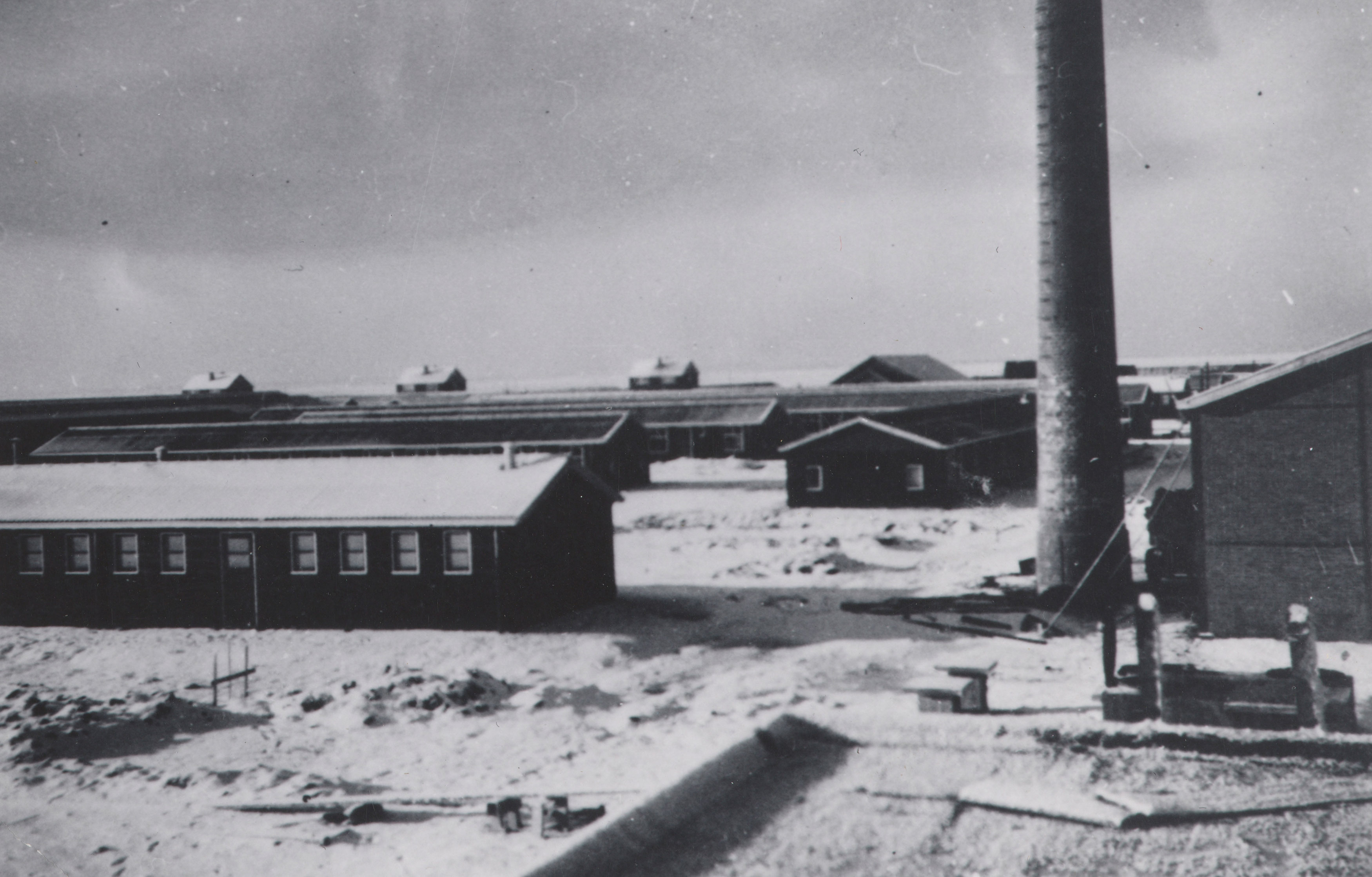
Westerbork was like a village with a lot of big shacks. The camp was surrounded by barbed wire fences and guard towers with Dutch police everywhere. Naturally, it filled us with a sense of dread.
© NIOD, Beeldbank WO2, No. 66383
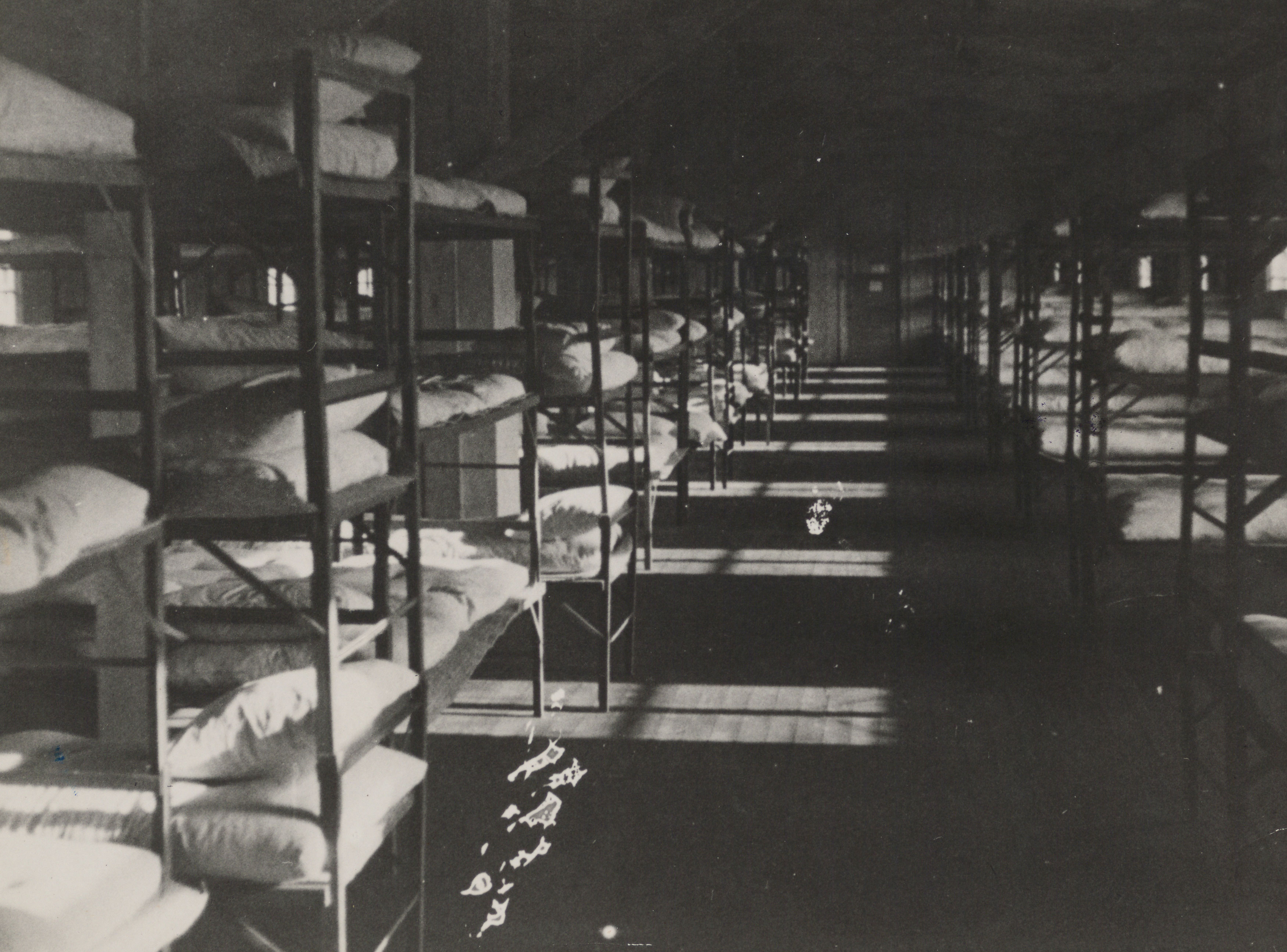
In the Westerbork camp, we lived in large barracks, several hundred people in each, with the men on one side and the women on the other. Weiter

I was 13 at the time and lived with my father. The bunk beds were three levels high. The food was decent, but not like at home, of course. Father had to work in an old battery recycling workshop for the German war effort. That meant that from morning to evening he sat in a workshop at a table, with many others like him, dismantling old batteries so that their components could be reused. At the end of the day, he came back tired and with hands filthy and black from the materials he had handled. A wound in his right thumb, which he got from the hard work, became severely inflamed at the base of the nail and later spread to the bone.
Mother worked part-time as a housekeeper and caretaker and stayed with my sisters.
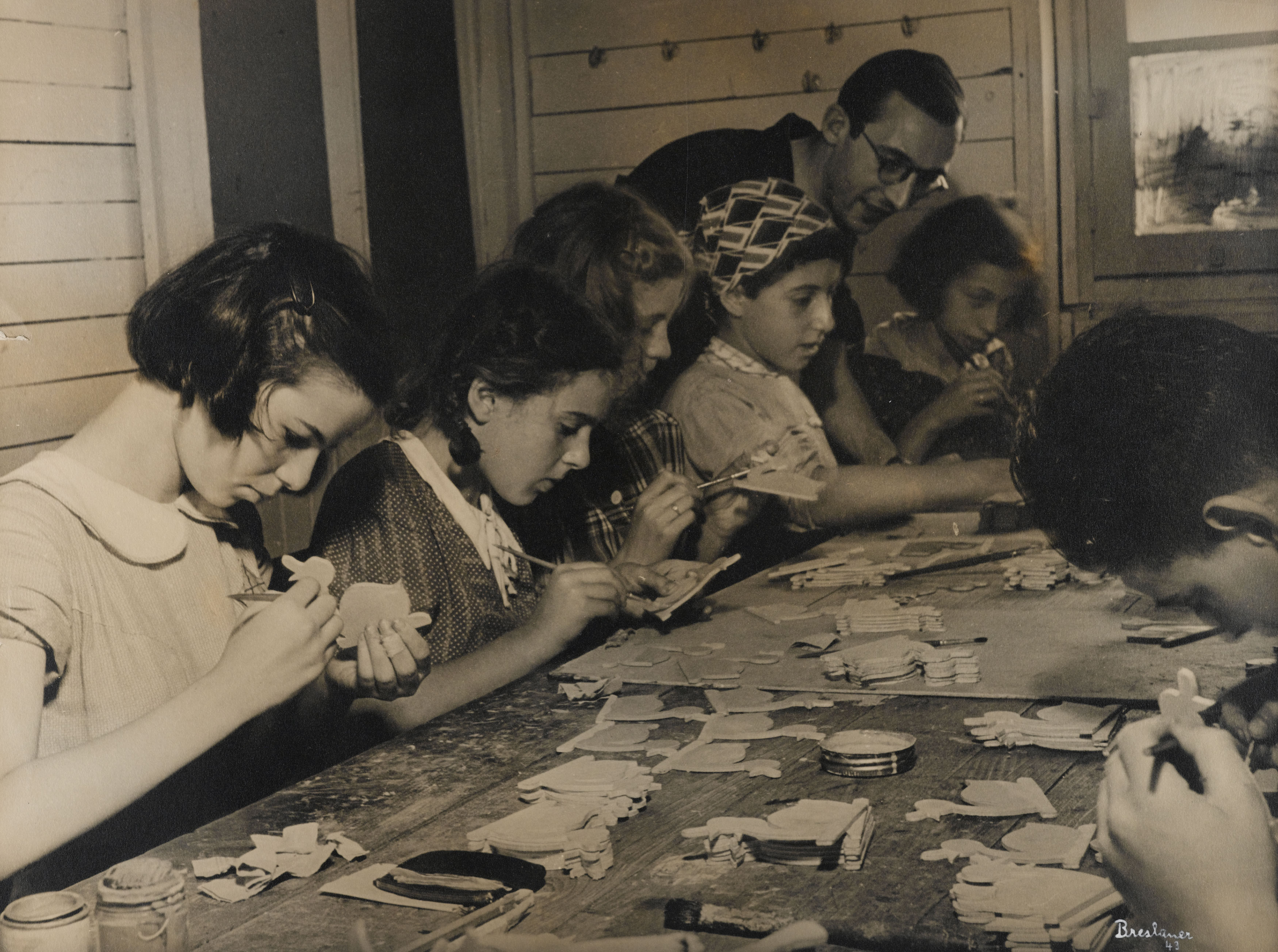
© Collection Jewish Museum, Amsterdam, No. F001656
There was a kind of ‘school’ and we played, running around outside when it wasn’t too cold or rainy. Weiter

I remember visiting a children’s home. Someone had drawn pictures on the wall there. It looked very cute. We also participated in the “art” class: they let us paint wooden toys – I don’t know who these toys were for – I remember painting a small white dog and adding hairy black spots to it by putting the brush perpendicular to the dog. I was told to do this, and I was very pleased with the method.
We, the boys, were employed as messengers because there were no telephone lines between the various offices and institutions in the camp.
In what way was life in the transit camp marked by contradictions?
The prisoners knew that Westerbork was a transit camp and that they were at risk of being deported. Nevertheless, something resembling everyday life existed in the camp, with work and school, and sporting and cultural events.
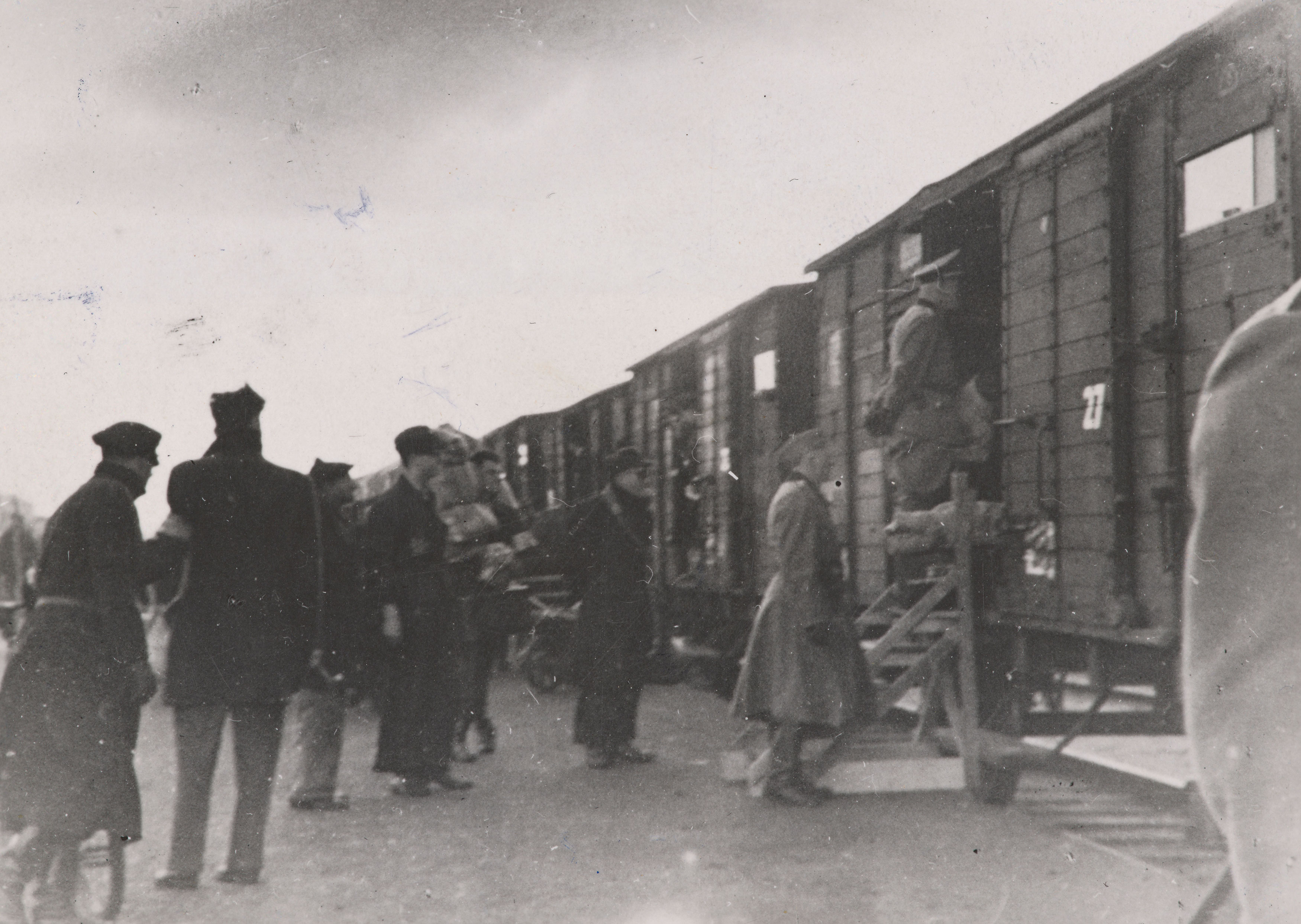
© NIOD, Beeldbank WO2, No. 66087
Westerbork wasn’t a concentration camp; it was a terrible transit camp. Weiter
Anyone who could, used favouritism to postpone being included in the next transport to Poland, obviously at the expense of someone else. It was a surreal camp.
On the one hand, there was a hospital and a clinic in the camp, and a school that operated intermittently. There was an orchestra, a choir and a cabaret.
On the other hand, and this is the worst thing I can remember, there was the cattle train, which slowly and defiantly rolled into the camp every Monday evening. I can still feel the silent terror that prevailed. The next day, the train set off with another 1,000 victims.
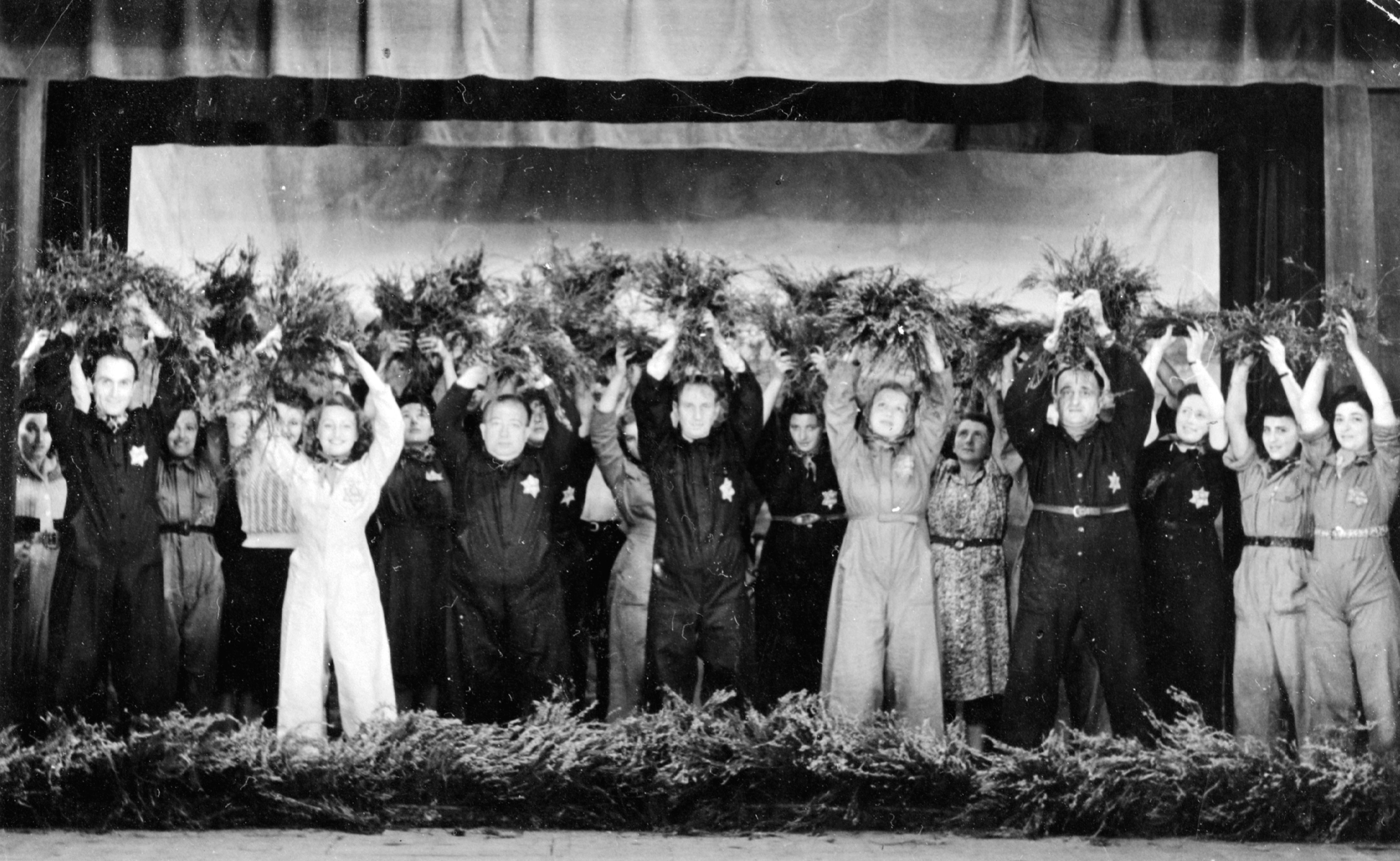
© Collection Jewish Museum, Amsterdam, No. F301987
There was an excellent orchestra and cabaret in the camp. Weiter
Clearly, the people who came to Westerbork were very talented. I still remember one song from the cabaret, in German: “Immer langsam, immer langsam, immer mit Gemütlichkeit, wir haben alle Zeit, es ist noch nicht so weit.” - “Always slowly, always slowly, always at your ease, we have all the time, the hour has not yet arrived.” The connection to bitter reality is still clear. Such was the surreal reality that dominated Westerbork, unbelievable contrasts. A fairly mundane lifestyle, until Monday night, when the gruesome cattle train slowly entered the camp.
That same night, about 1,000 names of victims were read out, who were taken by train to Auschwitz or Sobibor the next morning. This included people who the previous evening had played in the orchestra, performed cabaret, and children who had sung in the choir.
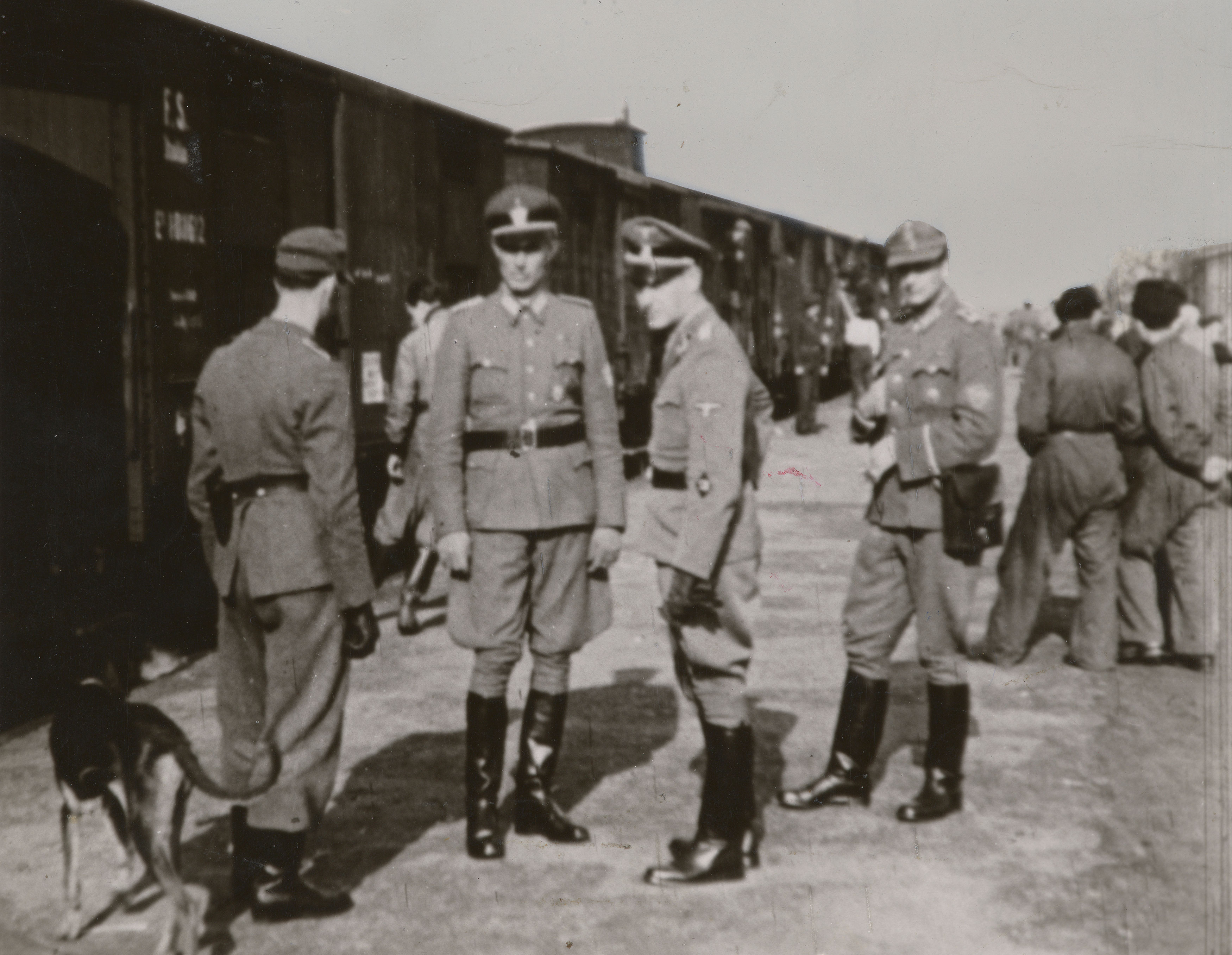
© NIOD, Beeldbank WO2, No. 66110
Gestapo officer Albert Konrad Gemmeker became camp commander of the Westerbork police transit camp on 12 October 1942. He organised the camp’s operations so that everything, including the deportations, proceeded without incident and, generally, without abuse. While the Jews, and in some cases Sinti and Roma, were being summoned to board deportation trains, Gemmeker limited his involvement to overseeing operations. In court, he later claimed that he had not known that the deportees were being murdered in the extermination camps. Although this was not very plausible, it helped him receive only a short prison sentence.
This photo, along with numerous others and film recordings from the camp, was taken by Rudolf Werner Breslauer. Breslauer, a professional photographer and cameraman, fled Germany in the autumn of 1938 and was interned in Westerbork from February 1942. In the autumn of 1944, he was deported to the Theresienstadt ghetto, then to the Auschwitz-Birkenau extermination camp, where he was murdered.
Not long after we arrived in Westerbork, we were summoned in the middle of the night. Weiter
We had to prepare for the upcoming transport, which was supposed to leave in the early morning. A good friend of my parents, Curt Blüth, was influential in the camp management and managed to get us off the list; our departure was postponed for now!
To this day, I think about the four unknown people who were sent in our place. It can be said that “the death of one is the life of the other.”
How did the Tal family learn that they had received the certificates to emigrate to Palestine?
The Red Cross International Committee sent a message to the Dutch Red Cross stating that the list of family members emigrating to Palestine had been approved and the certificates were ready.
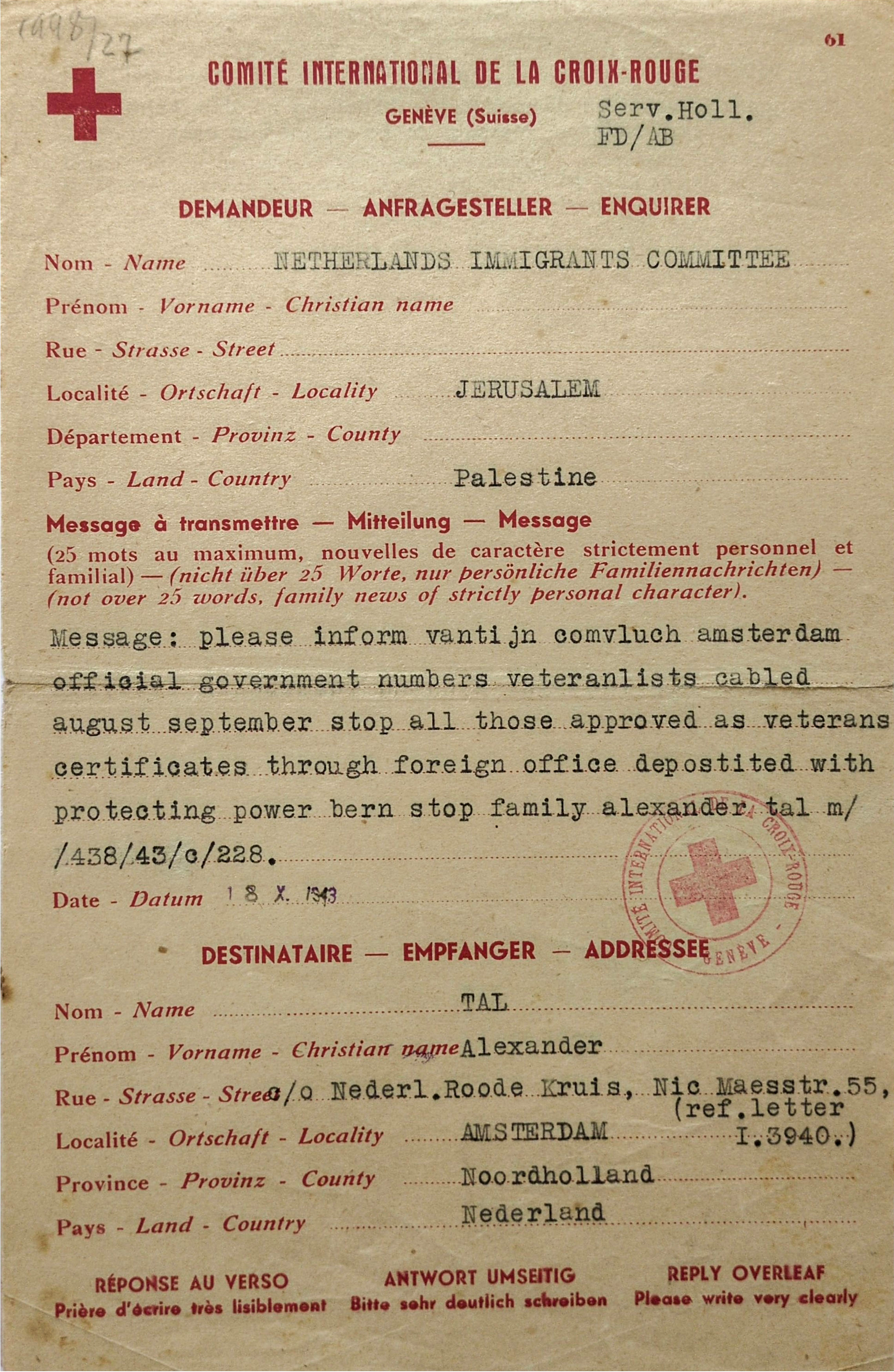
© Private property of the Tal family
Transcription
Genève (Suisse)
Serv. Holl. FD/AB
Enquirer
Name Netherlands Immigrants Committee
Locality Jerusalem
Country Palestine
Message (no more than 25 words, family news of strictly personal character)
Message: please inform van tijn com[ité] vluch[telingen] amsterdam official government numbers veteranslists cabled august september stop all those approved as veterans certificates through foreign office deposited with protecting power bern stop family alexander tal m/438/43/c/228.
Date/Datum 18.X.1943
Addressee
Name Tal
Christian Name Alexander
Street c/o Nederl. Roode Kruis, Nic Maesstr. 55, (ref. letter I.3940.)
Locality Amsterdam
County Noordholland
Country Netherlands
On 18 October, about two and a half weeks after our arrival in Westerbork, a message came from the Red Cross that all of our certificates to Palestine had been approved! Weiter
Only after I saw what a relief it was for our parents.... did I realise how great their anxiety about transport to a “Labour Camp” had been.
During the three months we stayed in Westerbork, the pace of transports had slowed: in October and November, there were only two transports.
I don’t remember much of the horror from the nights before the transports. In my memory, both nights became one night full of tension and excitement. The light in the hut remained on. That memory faded over the next two months. During this period, no more transports took place until the day we were sent.
How did the Tal family experience the deportation?
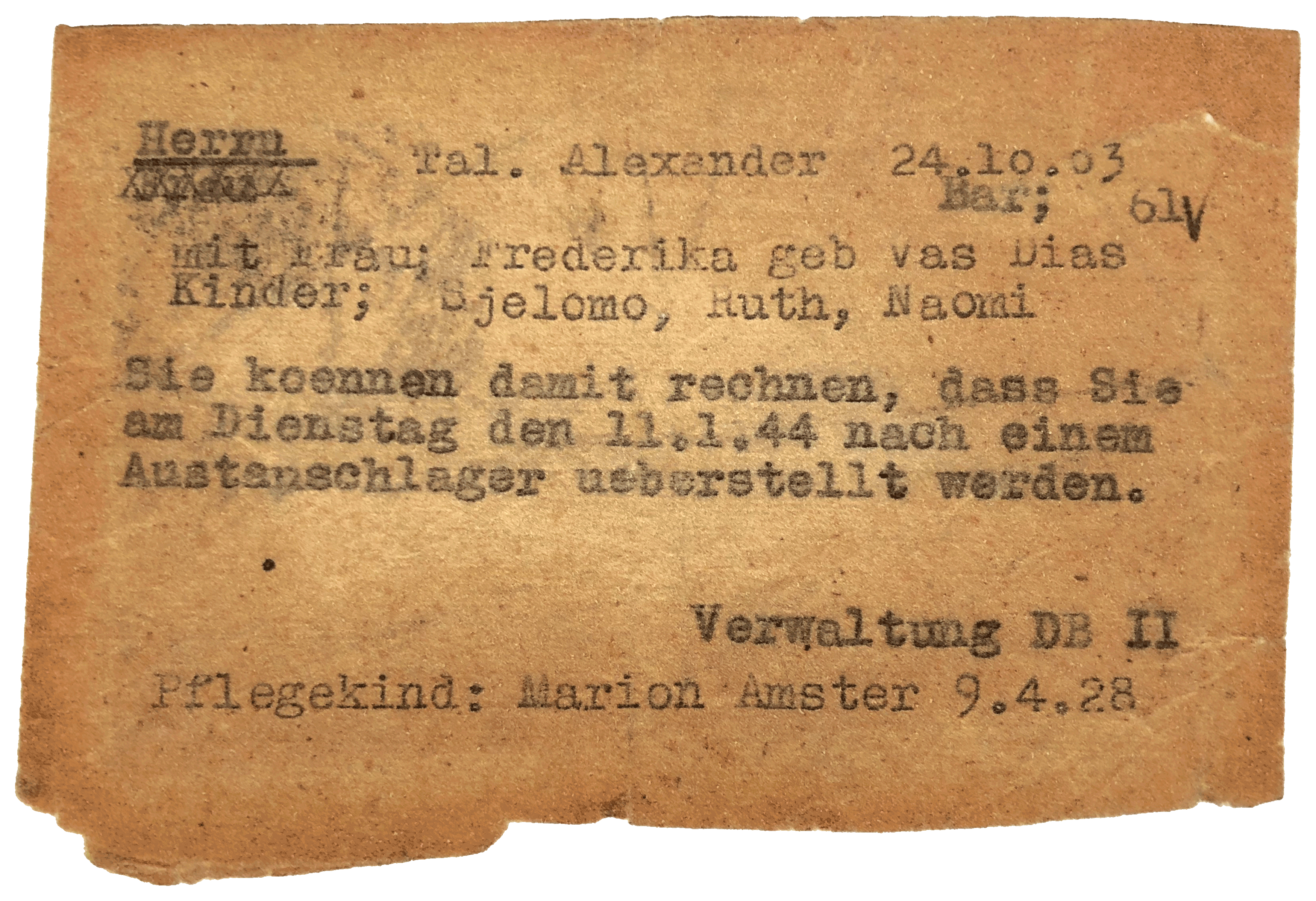
The Tal family was deported to the Bergen-Belsen concentration camp on 11 January 1944. They knew it was a so-called exchange camp. This gave them hope.
© Private property of the Tal family
Transcription
with wife Frederika, born vas Dias
Children; Sjelomo [that is Chanan], Ruth, Naomi
You can expect to be transferred to an exchange camp on Tuesday, 11.1.[19]44.
Administration DB II
Foster child: Marion Amster [born] 9.4.[19]28
On 11 January 1944, an old commuter train was waiting for us in Westerbork. It looked promising compared to the freight cars that took people to the death camps.
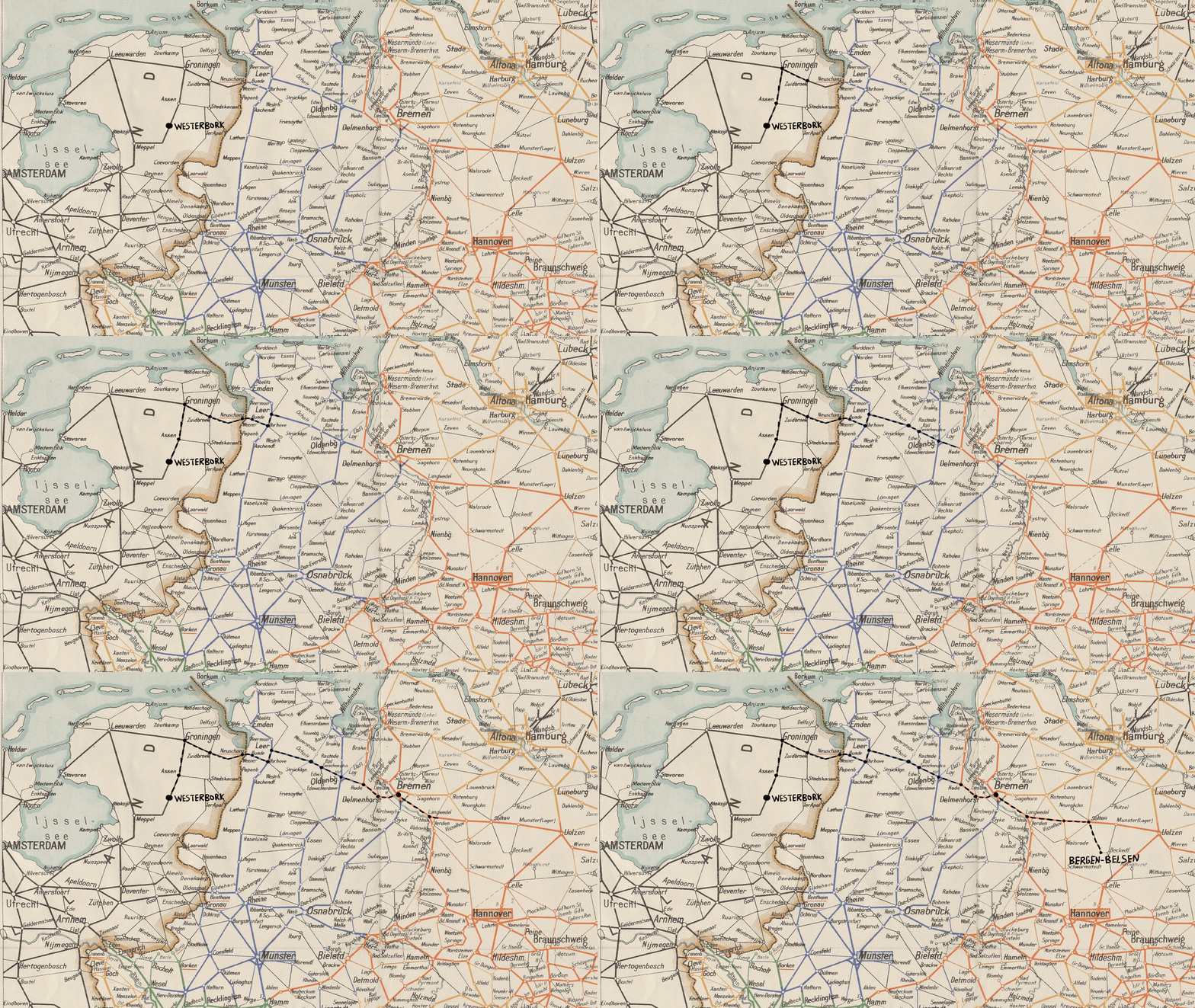
© Stadtgeschichtliches Museum Leipzig
On 11 January 1944, 1,037 Jews were deported from Westerbork to the Bergen-Belsen concentration camp.
Unlike the trains with freight cars that went to the extermination camps, the trains to Bergen-Belsen consisted of passenger cars. The journey in January 1944 took six hours. The route led from Westerbork to Hooghalen and continued north to Groningen, where it travelled eastward via Oldenburg and Bremen to the Bergen station.
When was the Levenbach family deported?
The Levenbach family was deported to Bergen-Belsen on 15 March 1944. Annelie, her brother Joost and her parents had been interned in Westerbork for 15 months. During this time, the family received papers to enter Palestine.
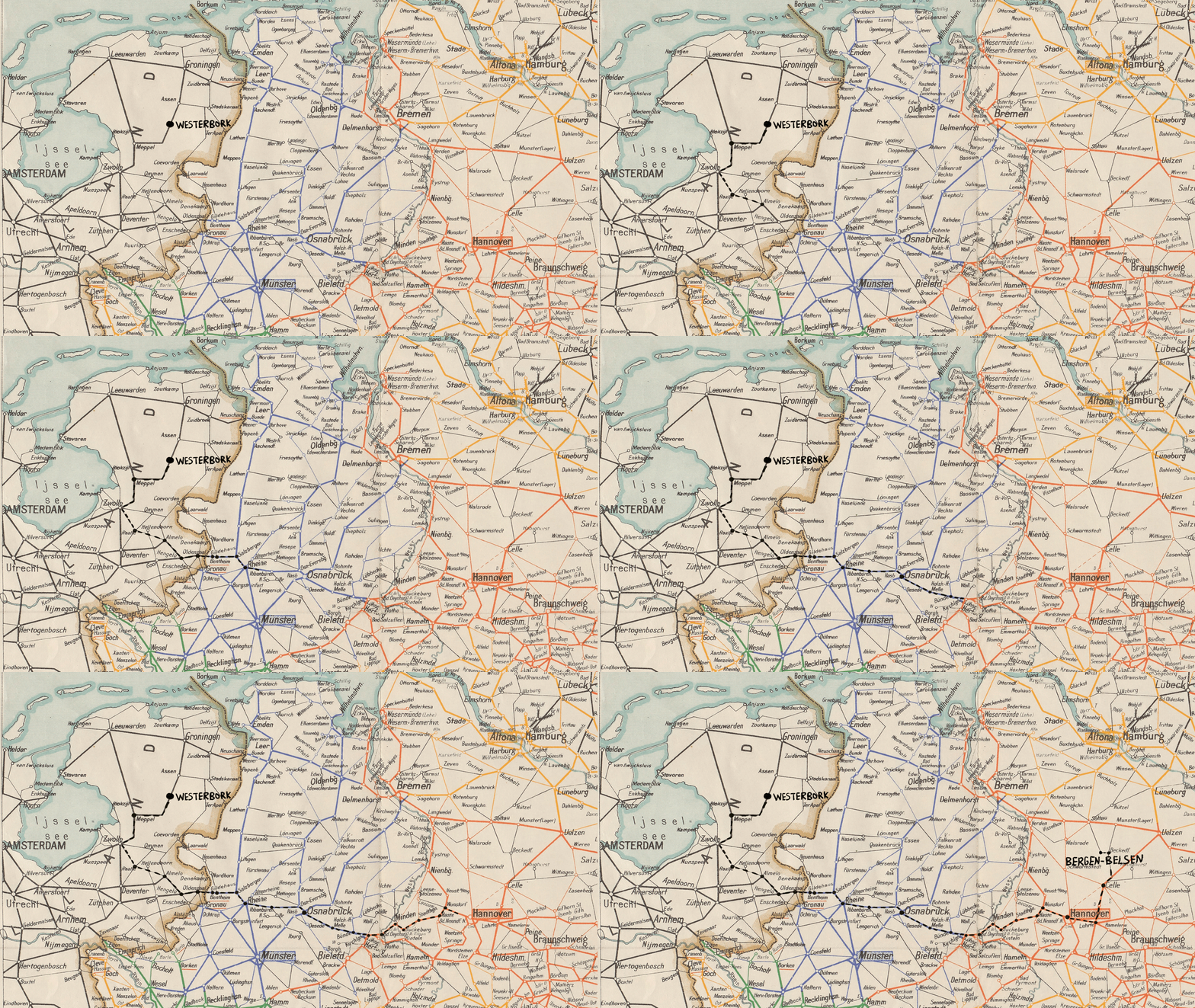
© Stadtgeschichtliches Museum Leipzig
On the transport of 15 March 1944, 210 Jews were deported to the Bergen-Belsen concentration camp, including 14 sick people and 44 children.
The train travelled south from Westerbork via Hooghalen, crossed the border between the occupied Netherlands and Germany at Bentheim, and continued via Osnabrück, Hanover and Celle to the Bergen station.
How did Annelie’s mother try to let her friends know that she was being deported?
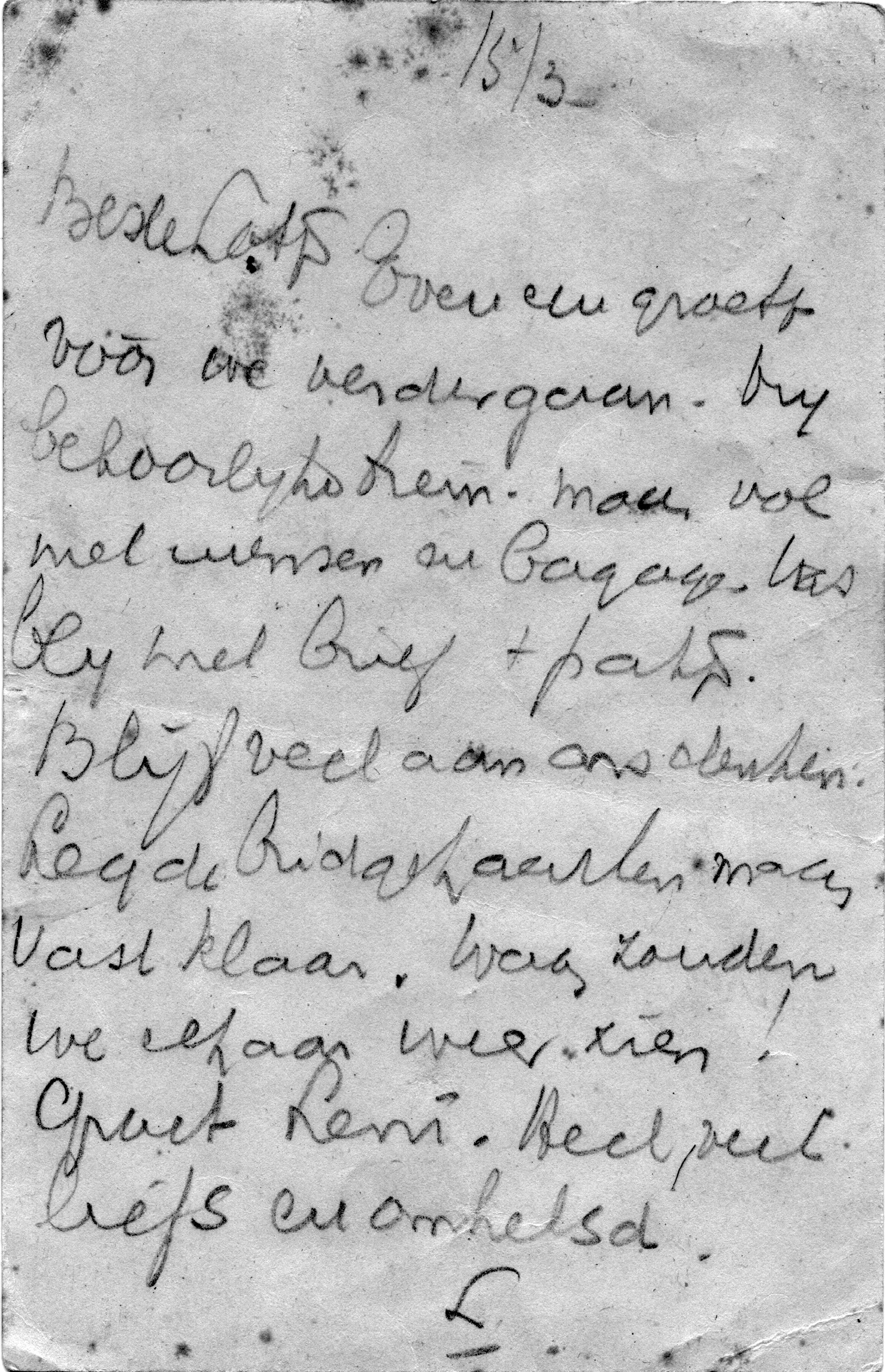
Before the train crossed the border between the Netherlands and Germany, Annelie’s mother threw a postcard out the window, addressed to a friend in Amsterdam. Someone evidently found the postcard and put it in a letterbox.
© Private property of the Tal family
Transcription
After the war, I was given the postcard. It is the only thing I have left in my mother’s handwriting.
When was the Reiner family imprisoned in Westerbork?
The Reiner family was sent to Westerbork after Dutch Nazis discovered their hiding place and murdered their father, Jo Reiner. The family was separated upon arrival at the camp on 9 February 1945.

© United States Holocaust Memorial Museum, Washington, D.C., No. 08049. Courtesy of Toni Heller
Transcription
[marked in green:]
8 Straf-Barakken – Punishment Barracks
Orphanage
Ziekenhuis-Terrein – Hospital Grounds
After the last deportation train left Westerbork on 13 September 1944, several hundred prisoners still remained in the camp, mostly Jews who had been held back for various reasons. There were also people who had gone into hiding and been discovered or betrayed who were interned in the punishment barracks in a separate area of the camp. Exceptions were made for children, the sick and the injured.
Mother and Sol were imprisoned in the punishment barracks and worked at dismantling batteries. Marco was sent to the orphanage, and I was in the hospital barracks. Weiter
I woke up in a clean bed. It was awful to wake up to a world where I knew Father was no longer.
Lying in bed in the hospital hut, I tried to imagine how he could have been saved, perhaps if he’d run towards the Moes family farm or towards Nieuwlande. Every time, I would awaken to the bitter and uncompromising reality of loss. Father made a sacrifice that made me admire him but also made me feel a sense of debt that I could never repay. The fact that I was shot and injured my leg made me a symbolic partner in his deed and this relieved, to some extent, my conscience.
© NIOD, Beeldbank WO2, No. 66243
By the time we arrived in Westerbork, there were no more transports to the East. Weiter
Despite this, our fear that they could resume persisted. We knew Aunt Eva had not been there since May 1943, but we did not know she was no longer alive... We received packages from the Red Cross. I was not hungry, and at my request, one of the nurses passed on my package to Mother and Sol. I was not hungry for food, but I was hungry for family.
The camp commander, Gemmeker, would walk around the camp with a stern and threatening expression. But on Passover he gave us permission to bake matzah and perform the seder until ten o’clock. There were people who knew when Passover was and knew the Haggadah by heart. I tasted the matzah, said “Pesach-Matzah-Maror” and fulfilled my Passover duty.
How long were the family members separated from one another?
Ab did not see his mother, Lou, his cousin, Sol, and his brother, Marco, again until after the liberation of the camp in April 1945. Once reunited, the surviving family members were finally able to mourn their murdered father together.
© NIOD, Beeldbank WO2, No. 66445
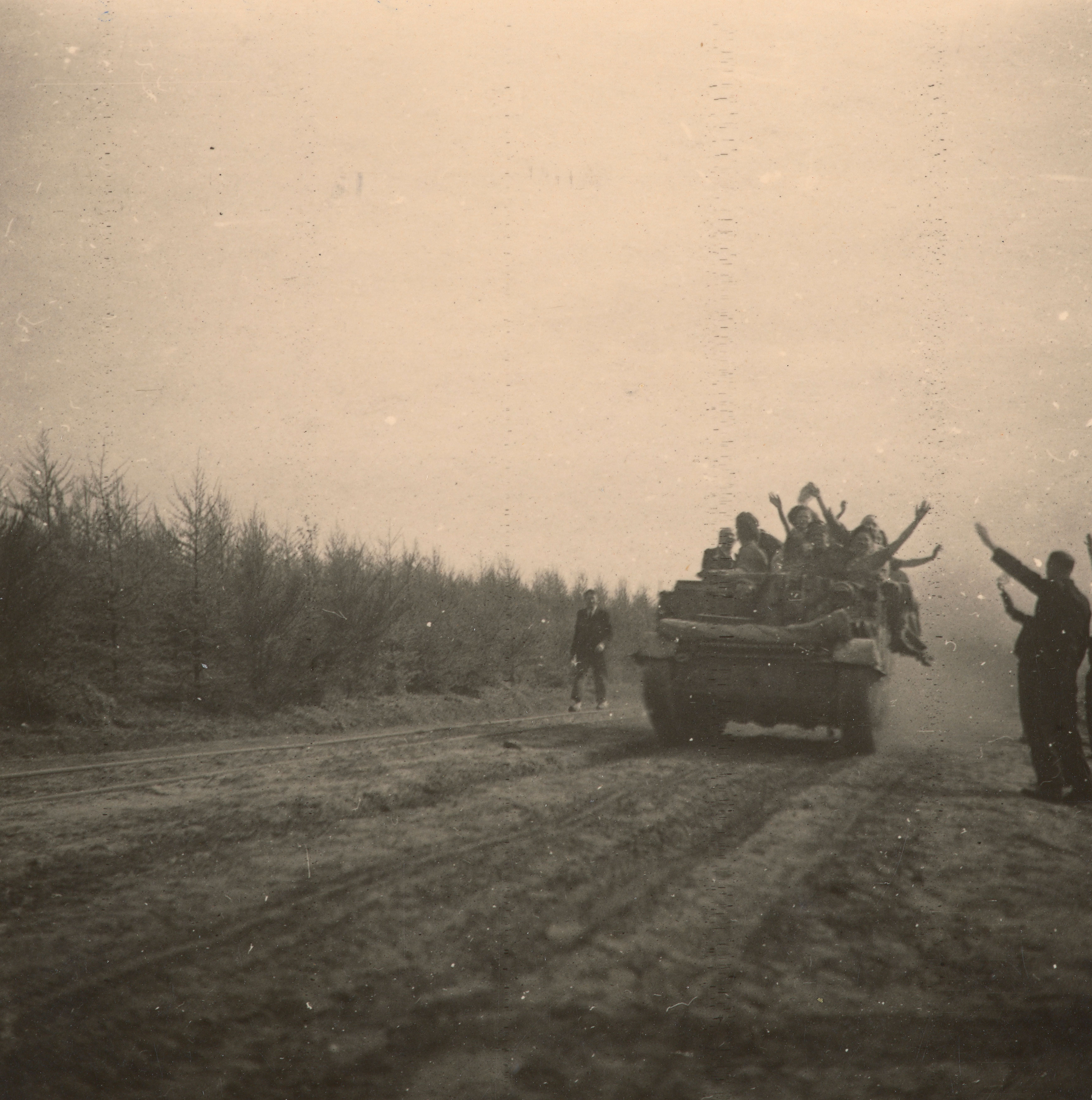
On 12 April 1945, Canadian troops liberated more than 850 Jewish men and women who had been left behind in the Westerbork transit camp. The previous day, the camp commander, Gemmeker, and his staff had left the camp, which was located in no man’s land between the front lines.
After their liberation, the former prisoners had to remain in the camp for many months. This was a safety precaution since there was still ongoing fighting. Moreover, the Canadian and Dutch authorities wanted to investigate why these Jewish prisoners had not been deported and determine whether they had collaborated with the German occupiers. The last prisoners were not allowed to leave the Westerbork camp until early July 1945.
In the moment when the war ended and the camp was liberated, I did not feel joy. Weiter
It was not a happy day. I was almost 16, and I knew I had lost my father. He who knew how to make decisions for all of us, to take care of us all.
I knew that now nothing would be as it was. Father would no longer come to hold my hand. As long as Father was with us, I could argue with him. Conduct an all-knowing teenage struggle. Once I lost him, I realised how central he had been in my life. How good, smart and protective Father was.
The Canadian and Polish soldiers liberated the camp, but following the liberation, Father was not resurrected; no one was resurrected. The liberation only sharpened the recognition of the magnitude of our disaster.
Why did Jo van der Helm, who had hidden the Reiner family in her home, come to the Westerbork camp after liberation?
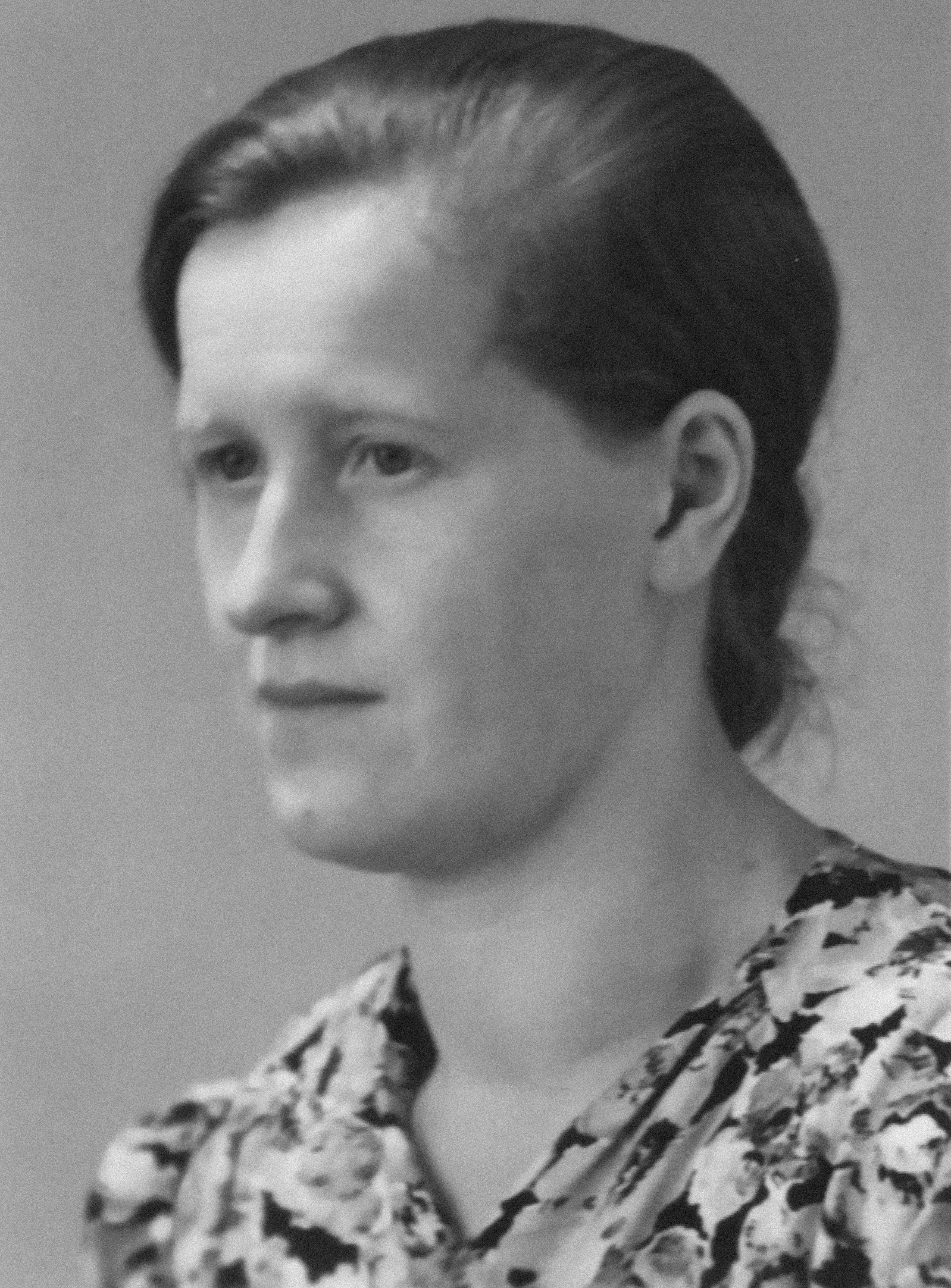
Jo van der Helm knew that Jo Reiner had been murdered and wanted to find out what had happened to the rest of the family. She went to Westerbork to visit them. She also told them about the death of Jan van der Helm.
© Private property of the Rinat family
One morning Jo appeared at the camp. She brought information with her that we were missing in the story of our capture. Weiter
The Nazis who discovered the hiding place went to Jan, who was working in the field, and asked him: “Who do you have in your home?” Jan started running away. He was chased by one of the Nazis, someone from the village whom he knew and had worked with in the past, and shot dead.
Jan paid with his life and Jo was widowed because they insisted on hiding us. Because they did not let fear outweigh their commitment to others. Jo continued to care for our well-being. Continued to be Jo.
© Private property of the Rinat family
Why did these people risk their lives for us by hiding us? Weiter
I think their actions were done out of an inner conviction. I asked Jo years later why she did what she did, “It’s quite simple, you cannot leave people in distress without help,” she said. The heavy price she paid did not make her regret the deed she did. Her personality was strong, special and inspiring.
Father and Jan van der Helm were buried in Hollandscheveld in a plot where pilots from the West whose planes were shot down near the village were buried. On Jan’s tombstone is written: “Here rests until the youngest day the remains of our beloved husband and father Jan van der Helm”.
The first train left the Westerbork police transit camp for the Auschwitz concentration and extermination camp on 15 July 1942. Over the next two years, approximately 100,000 Jews were deported from Westerbork in 93 transports. Most trains went to Auschwitz, but some arrived in the Sobibor extermination camp, the Bergen-Belsen concentration camp and the Theresienstadt ghetto.
Of the 107,000 Jews who were deported from the Netherlands, only 5,000 experienced the liberation. An additional 245 Sinti and Roma were also deported, of whom roughly 30 survived.
The deportations were largely organised from the Reich Security Main Office in Berlin. The “Judenreferat” (Jewish Affairs Department) IV-B-4, headed by Adolf Eichmann, determined how many Jews would be deported and when. In the Netherlands, the “Jewish Affairs Department” of the German Security Police and Security Service in The Hague implemented the instructions from Berlin. It informed the camp commander of Westerbork how many Jews were to be transported on any given day. The camp commander was responsible for selecting the people to be deported, a task he usually passed on to the Jewish employees of the camp administration.